
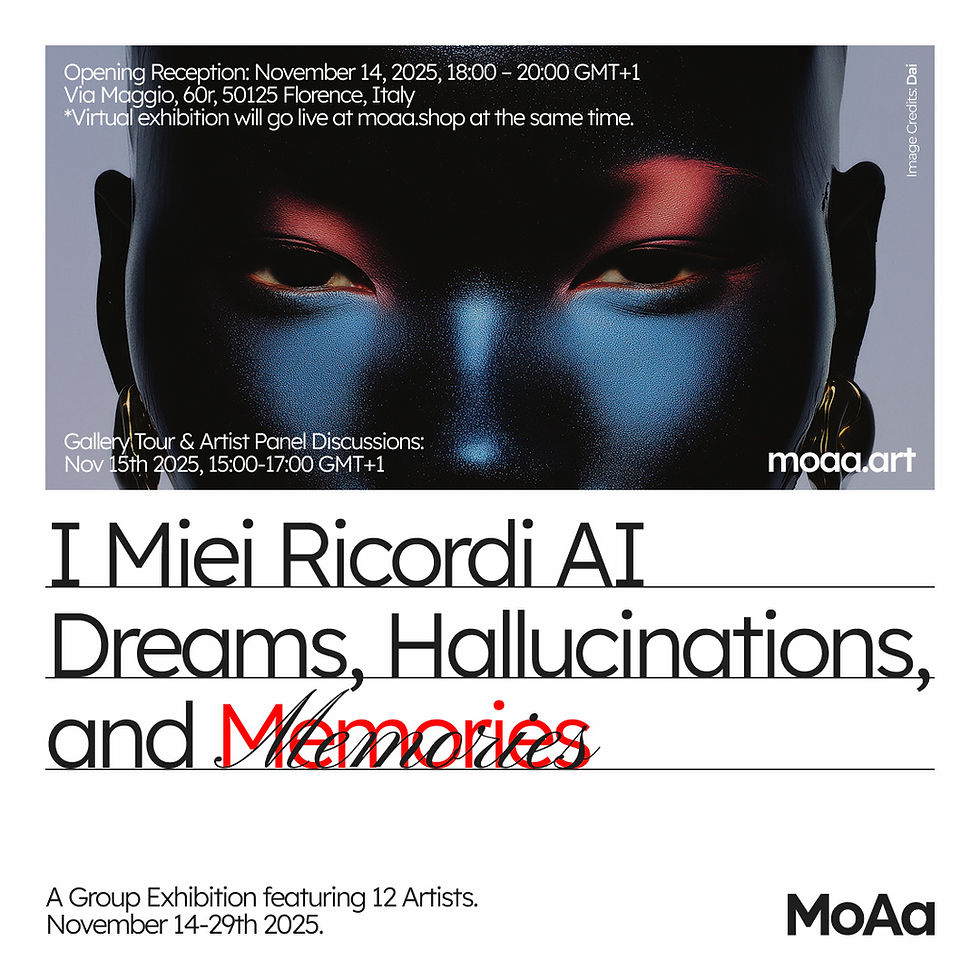
The Museum of Artificial Art opens its inaugural exhibition "I Miei Ricordi – AI Dreams, Hallucinations, and Memories"
n Florence on November 14, 2025
Ville & Casali celebrates its 400th issue by interpreting the concept of quality living, a theme that has long defined the identity of this historic italian magazine which, since 1990, has showcased the most beautiful homes in italy and around the world, uniting style, elegance, and the art of dwelling.
In collaboration with Prompt Magazine, this concept is explored through six digital artists who introduce a contemporary reflection on the idea of home, examining how digital media and artificial intelligence can expand our perception of space, emotion, and everyday living.


Dai

Mindeye
Participating Artists
The Museum of Artificial Art, Exploring how human and synthetic visions intertwine in the collective memory of our time.

Joy Fennell

Infrarouge

Maddy Minnis

Dullia

ctrl_cd

Circus of Artifice

Laura Buechner

Parallel.fbx

Serifa

Vixy

On November 14, 2025, MoAa will open its inaugural exhibition at Via Maggio 60r, Florence, with a opening reception followed by artist panel discussions and dynamic conversations with theorists on November 15.
The show unites 12 international artists who work at the intersection of AI, identity, and digital consciousness—including Joy Fennell, Dai, Maddy Minnis, Laura Buechner, Parallel.fbx, and others—each contributing to a collective reflection on how memory, perception, and imagination evolve in the post-human era.
Curated by MoAa, I Miei Ricordi examines the blurred line between human recollection and AI states of consciousness. The exhibition asks a deeply poetic question: who dreams, and who remembers? Across surreal portraits, algorithmic hallucinations, and speculative landscapes, AI becomes a co-author of visual culture—hallucinating new worlds, reframing collective memory, and rewriting visual history through digital collaboration
.
The show unfolds both in person and online, extending into a virtual exhibition hosted on moaa.shop, positioning Florence, the cradle of the Renaissance, as the stage for a new cultural paradigm of vision and imagination.
Debora Hirsch Sylva Bird.
Sylva’s birds are wild: unlike my plants, they belong to no classification. They appeared algorithmically, unexpectedly, and without being summoned. A life that resists boundaries: it seeps through, mutates, proliferates beyond taxonomies and archives. Sylva Bird embraces this ungovernability, proposing not a restorative nostalgia but an ethics of cohabitation with the hybrid, the unpredictable, and the indeterminate. A commitment to rejecting ideals of purity, resisting the allure of simplistic binaries, and inhabiting those dense and generative spaces where life persists in ways that are at once unpredictable and uncontainable. These birds are not monuments to disappearance, but gestures of vitality in the making—inhabitants of a world where meaning proliferates not through the recovery of what has been, but through the improvised unfolding of what remains possible.
Are we teaching AI to see, or is AI teaching us to dream?
In a world where machines are increasingly capable of creating, one question looms larger than all others: Are we teaching AI to see, or is AI teaching us to dream? This is not merely a philosophical musing, it is a direct challenge to our understanding of creativity itself. As artificial intelligence evolves, it forces us to reconsider the boundaries between human imagination and technological possibility.
Generative AI, which can now produce entire worlds from a few typed words, asks us to confront an uncomfortable paradox: is the artist still the creator, or has the machine become an equal partner in the act of creation? The Museum of Artificial Art (MoAa) describes AI as a “site of resistance, speculation, and cultural imagination,” suggesting that this collaboration between human and machine is no longer just a technical process, it’s a new way of seeing, a new way of dreaming.
And as we stand at this crossroads, we must ask ourselves: who is really doing the dreaming?
The answer may be more complex than we think.
From the essay “Are we teaching AI to see, or is AI teaching us to dream?” by Vittoria Mascellaro , exploring the poetic dialogue between human and synthetic intelligence.

