
Nataliya Grimberg - Beyond The Perfect
Nataliya Grimberg on cultural direction, uncanny beauty, and why the best AI visuals never feel generic
Nataliya Grimberg
Is a fashion futurist, creative director, and founder of Haute Future – an innovation lab working across fashion, AI, immersive storytelling, and next-generation visual production. Her work combines original photography, AI image development, video production, and strong conceptual direction to create visuals that feel culturally sharp, emotionally precise, and visually ahead of the market.
Nataliya explores the uncanny valley not as a glitch, but as a visual language.
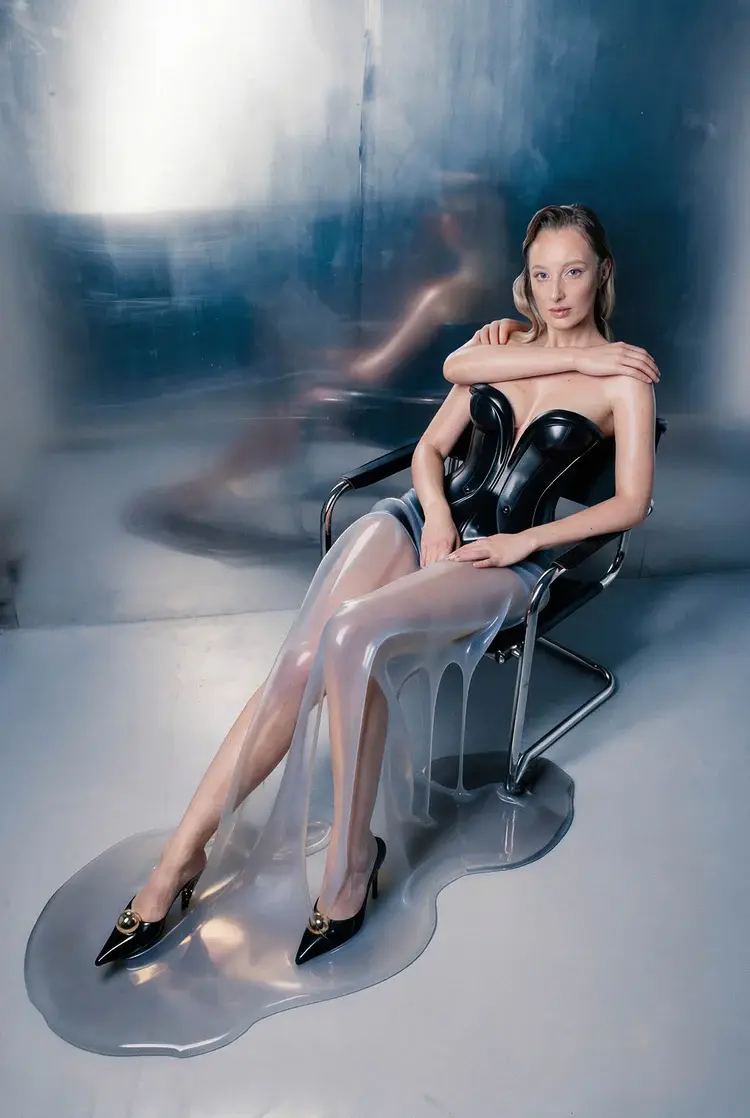
The images are polished, sensual, and highly controlled, yet something remains subtly unstable: a duplicated gesture, a body seen through the logic of a machine, a beauty ideal pushed just slightly too far.
The result is less about AI novelty and more about authorship – about what happens when technology is directed with taste, cultural context, and a clear point of view.

This editorial feels polished, but also subtly unsettling.
What were you interested in exploring?
I was interested in that exact threshold where an image becomes almost too perfect.
A few years ago, AI visuals were mostly discussed through their failures – too many fingers, strange anatomy, awkward hands. At the time, those things were treated as limitations. Now the technology has become much more precise, and with the right direction it can create genuinely beautiful images. What interests me is what happens after that point: when the image is no longer obviously broken, but still just slightly off. A gesture is duplicated, a limb feels over-resolved, the body looks as though it has been refined a little too far.
That space is fascinating because it says something real about how we see ourselves through machines. The body stops being just photographed and starts being interpreted, predicted, optimized. That is where the uncanny valley becomes useful again – not as error, but as atmosphere.

"...The difference is not access to the tool. It’s authorship."
A lot of people are using AI tools now. What makes your approach different?
For me, the difference is not access to the tool. It’s authorship.
What I bring is a cultural and creative framework around technology. I come from fashion, visual storytelling, future research, and concept development, so I’m not looking for generic output or novelty for novelty’s sake. I’m looking for a visual language that feels intentional – something that understands beauty, tension, luxury codes, atmosphere, and the wider cultural conversation around the image.
That’s why I don’t really see this as “AI art” in the simplistic sense. It’s closer to creative direction through a hybrid medium. The technology is one layer, but the real value is in how you shape it – what references you bring, what you choose to keep, what you reject, and how you build a world that still feels authored rather than automated.


This feels bigger than one editorial. How does it connect to your broader work?
Quite directly, actually.
A lot of what I do is about building visual worlds that sit between physical reality and synthetic imagination. Sometimes that takes the form of an editorial like this.
Sometimes it becomes a campaign concept, a moving image piece, an immersive environment, or a hybrid shoot that combines real garments, real talent, and digitally created worlds.
That’s really the foundation of Haute Future. I built it as both an innovation lab and a creative studio – a space where fashion, technology, and visual storytelling can genuinely inform one another. I’m interested in how brands can use emerging tools without losing elegance, authorship, or emotional depth. The goal is never to make something look “AI.” The goal is to make it feel new, precise, and culturally ahead.

You’ve worked across fashion, AI, and immersive production. What does hybrid image-making actually look like in practice for you?
For me, hybrid means not thinking in binaries. It’s not photography or AI. Not physical or digital. Not “real” or “generated.” The most interesting work happens when those layers are directed together.
A project might begin with a real shoot and then evolve through AI image development and post-production, like what you see in this editorial for Prompt Magazine. Or it might start with a generated visual world that later gets translated into a physical production, like the glassware shoots we did with Artel. In another case, it might involve virtual production, where a live model and real garment are placed inside a digitally created environment.
That’s something I explored, for example, in a project for Preciosa, where I created animated AI-generated backgrounds for a virtual production studio. We had a real model, real styling, and a real shoot, but she was immersed inside a shifting visual world that had been designed digitally. I love that kind of setup because it moves beyond novelty. It becomes a true hybrid image system.

Your work also extends beyond editorials and campaigns into immersive experiences. How does that side of your practice connect to what we see here?
Very naturally. I’m interested in building worlds, not just images, so it makes sense to me that the work moves across formats. Sometimes that becomes a viral campaign, sometimes a retail activation, and sometimes it expands into film, AR-powered editorial, or an immersive event environment.
One example is our work for Planetum, Europe’s largest LED planetarium, where we created a fashion film designed specifically for a large-scale 360 setting. That kind of project reflects how I think – not only about the image itself, but about atmosphere, narrative, scale, and how a visual idea lives inside space.
For the Prototyp Festival, we created both videomapping for the unique space of a massive water reservoir, and LED-integrated 3D printed looks that matched the music beats and projections. Accompanying sound and narration were also AI generated, so a full 360 production really. I’m always asking how to create a visual world that people actually feel inside.
What should a potential client understand when they see work like this?
A lot of brands want to work with new technologies, but they don’t necessarily want the result to feel cold, generic, or trend-chasing. What we offer is a way to translate innovation into image that still feels desirable, elevated, and emotionally precise. And that is not just about generating images. It’s about designing a visual language that feels future-facing and brand-first.
At its core, Haute Future is about connecting advanced aesthetics with strong concepts. We work across fashion, beauty, luxury, and technology, helping create projects that feel more layered and more forward than a standard campaign. That can mean AI-enhanced editorials, hybrid video campaigns, phygital events, fashion show concept development, or larger immersive storytelling. That’s the real offering: not isolated content, but culturally informed world-building.

"But the work only becomes meaningful when someone is actually directing that complexity well. That’s the part I care about most."
Toward more layered authorship. I don’t think photography disappears. I think it becomes part of a richer ecosystem. The same is true for AI. It won’t replace creative direction – it will raise the bar for it.
The most exciting future isn’t one where everything is synthetic. It’s one where image-making becomes more fluid, more cinematic, more intelligent. Where brands can prototype worlds faster, test aesthetics earlier, and build visual identities that stretch across editorial, campaign, digital, immersive, and spatial formats.
But the work only becomes meaningful when someone is actually directing that complexity well. That’s the part I care about most.

