Ninety Percent of Everything installation
The Invisible Connections Moving Across the Sea
4 September – 4 October 2026 Genoa Italy
Artists and researchers aboard a cargo ship transformed the hidden flows of maritime logistics into data, images and sound.
Based on practices of data visualization and data sonification, Ninety Percent of Everything turns maritime traffic, underwater signals, scientific datasets and human testimonies into an audiovisual system in constant connection with the sea.
From 4 September to 4 October 2026, the installation will be presented at Palazzo Ducale in Genoa, as the outcome of an artistic residency that brought artists, researchers and sound practitioners inside the operational port, scientific research facilities and aboard the cargo ship Grendi.

We rarely see the infrastructure that makes global circulation possible. Ships move beyond our field of vision, data travels continuously between vessels and ports, goods cross oceans before entering everyday life, while ecological systems, labour, geopolitics and consumption remain bound together within the same network. Ninety Percent of Everything begins precisely from this largely invisible territory.
Developed by U-BOOT Lab, and curated by Maria Pina Usai, in collaboration with Fish Tank, Fathom 30°, data artist Tiziana Alocci, sound factory Stellare and photographer Simone Lezzi, the project uses art not simply to illustrate the complexity of maritime logistics, but to make its relationships perceptible. Signals become sound, routes become moving images, scientific measurements coexist with voices and portraits, while live navigation data keeps the installation connected to what is actually happening in the port.
The result is less a representation of the sea than a way of reading the systems that pass through it: a constantly changing portrait of the connections between technology, ecology, labour and global consumption, and of the position we occupy within them.
The Port as an Invisible Infrastructure

The work, in fact, investigates the relationship between maritime logistics and the climate crisis, understood as a systemic outcome of the interconnections between ecology, labour, economic and geopolitical dynamics, and global consumption.
Based on data visualisation and data sonification techniques, the installation draws on datasets from scientific research, maritime logistics and fieldwork carried out during the residency as the subject matter for its artistic exploration. Moving images, sounds and photographs, alongside data relating to shipping flows, marine biodiversity, port infrastructure, cargo and maritime labour, are interwoven with testimonies gathered in the field, and translated into an audiovisual language capable of making normally invisible relationships perceptible. Rather than only representing the data, the work interprets its connections, transforming diverse information into an experience that invites the public to question their own role within this system.
As curator Maria Pina Usai states, “The project proposes a reversal of perspective with regard to an interpretation that views maritime logistics exclusively as a cause of environmental impacts, and invites us to question the role each of us plays in sustaining this system through our daily consumption choices. The aim is not merely to make an infrastructure that is normally invisible visible, but to shift the public from being spectators to becoming directly involved participants. From this perspective, Ninety Percent of Everything recognises the capacity of artistic and cultural practices to construct new imaginaries and to foster forms of awareness that can help steer behaviour towards greater sustainability, in line with the objectives of the Starter – Culture and Creativity for the Environmental Challenge* call for proposals.”
Turning Maritime Data Into a Living Audiovisual System

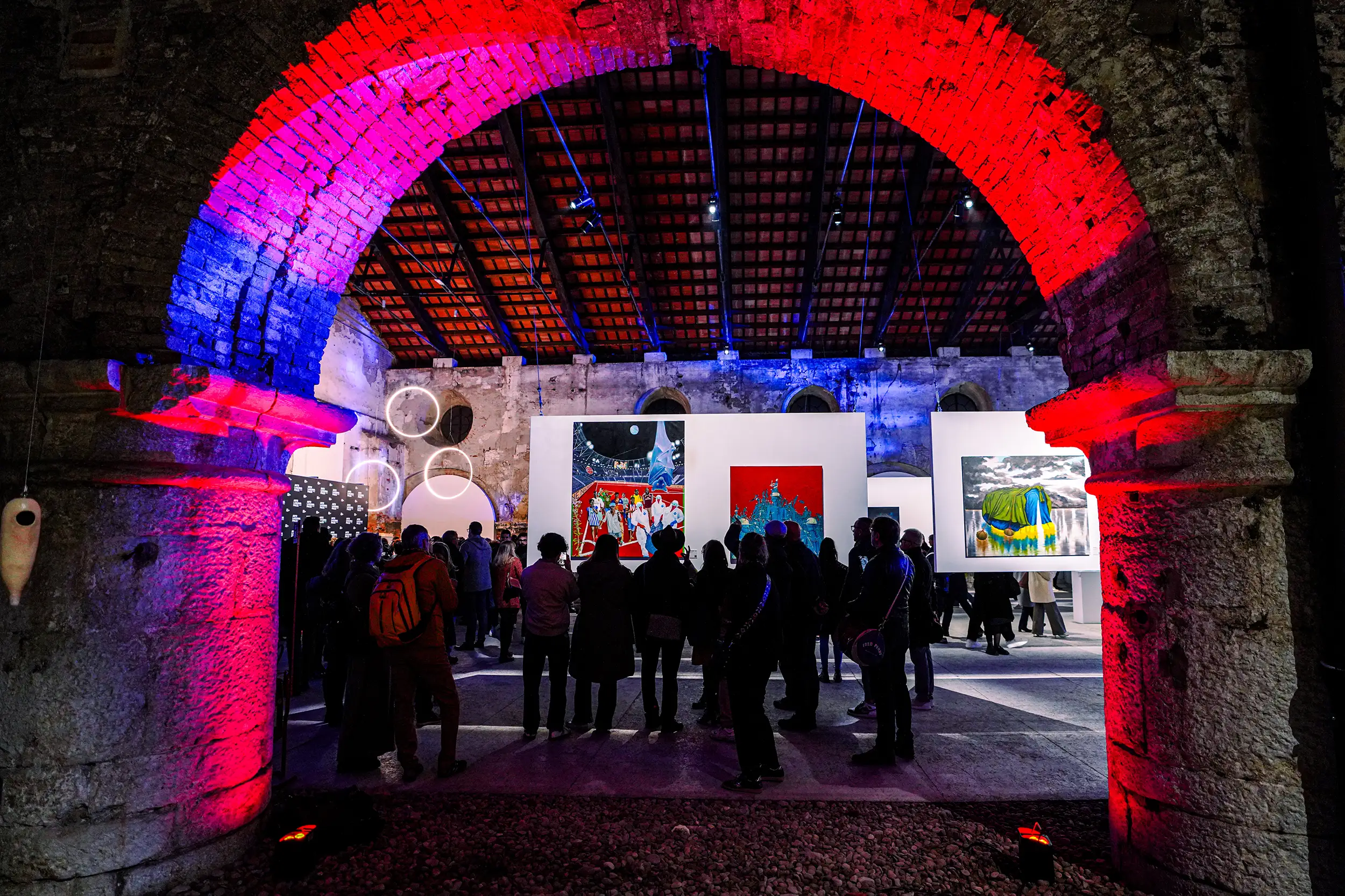
Ninety Percent of Everything installation.
The audiovisual installation consists of a two-channel projection, accompanied by two visualisations that display, in real time, navigation flows and data generated by communications between ships.
The projection forms the centrepiece of the work and comprises moving images, sound recordings, data visualisation, data sonification and image-to-sound systems, in which scientific, logistical and documentary data intertwine with the testimonies gathered during the artist’s residency. The interviews, together with the portraits created by Simone Lezzi, give a voice and a face to the people who, through their work, enable maritime logistics to function, placing the human experience in dialogue with the data that describe the system. What emerges is a narrative of the port and maritime system as an infrastructure that connects ecologies, economies, labour, technologies and global consumption.
Alongside the main projection, two suspended projection screens display visuals that update in real time, keeping the installation constantly connected to the processes of maritime logistics. The first is fed by a receive-only AIS/VHF antenna, of the same type as those commonly used on board ships and boats. The antenna, previously used by the Fish Tank collective during their artist residency, is installed within the exhibition space and receives only AIS (Automatic Identification System) messages transmitted in clear text by vessels navigating in the port of Genoa. The data received is processed and translated into a generative visualisation that makes the invisible communications between ships, the port and coastal infrastructure perceptible.
The second visualisation presents a dynamic map of cargo ship traffic on a larger scale, generated from AIS data sourced from global maritime monitoring networks. The routes of cargo ships are continuously updated, situating the port of Genoa within the international logistics system and revealing the global scale of the infrastructure that underpins the movement of goods.
The two visualisations introduce an open and constantly evolving temporal dimension to the installation. Each visit corresponds to a different configuration of the data, generated by the actual movements of the ships at the very moment the public passes through the exhibition space.
The installation is accompanied, in the adjoining room, by maps, notes, scientific references, datasets, images and working materials produced during the residency,
which document the research process and the relationships forged between artists, researchers, scientific institutions and port system operators. Conceived as a constantly evolving space, the exhibition will continue to transform throughout its duration through contributions arising from the public programme, which centres on meetings, workshops and opportunities for discussion. Participants will be invited to share their own relationship with the port and seafaring, contributing to the creation of a shared heritage of memories, experiences and relationships. A selection of the materials collected will be included in the project’s final publication, extending the scope of the research beyond the residency and the exhibition.
Ninety Percent of Everything installation
4 September – 4 October 2026
Palazzo Ducale Genoa Italy
Project by U-BOOT Lab
in collaboration with Fondazione Palazzo Ducale Genova
under the patronage of Observatoire des publics et des pratiques de la culture – MESRI/AMU, CNR-IRBIM
with contributions from Stellare, Itinerari Paralleli, The Heath² Studio, NECESSITY.INK, Laboratorio di Sociologia Visuale UniGe
with the support of Western Ligurian Sea Port Authority, Grendi, ETT, CS-MACH1
with funding from:
Compagnia di San Paolo Foundation – ‘Starter – Culture and Creativity for the Environmental Challenge’ call for proposals